Nvidia $500B AI Plan Could Reshape GPU Financing
Nvidia's $500 billion AI financing push could transform how data centers are funded while creating a stronger secondary market for aging GPUs.
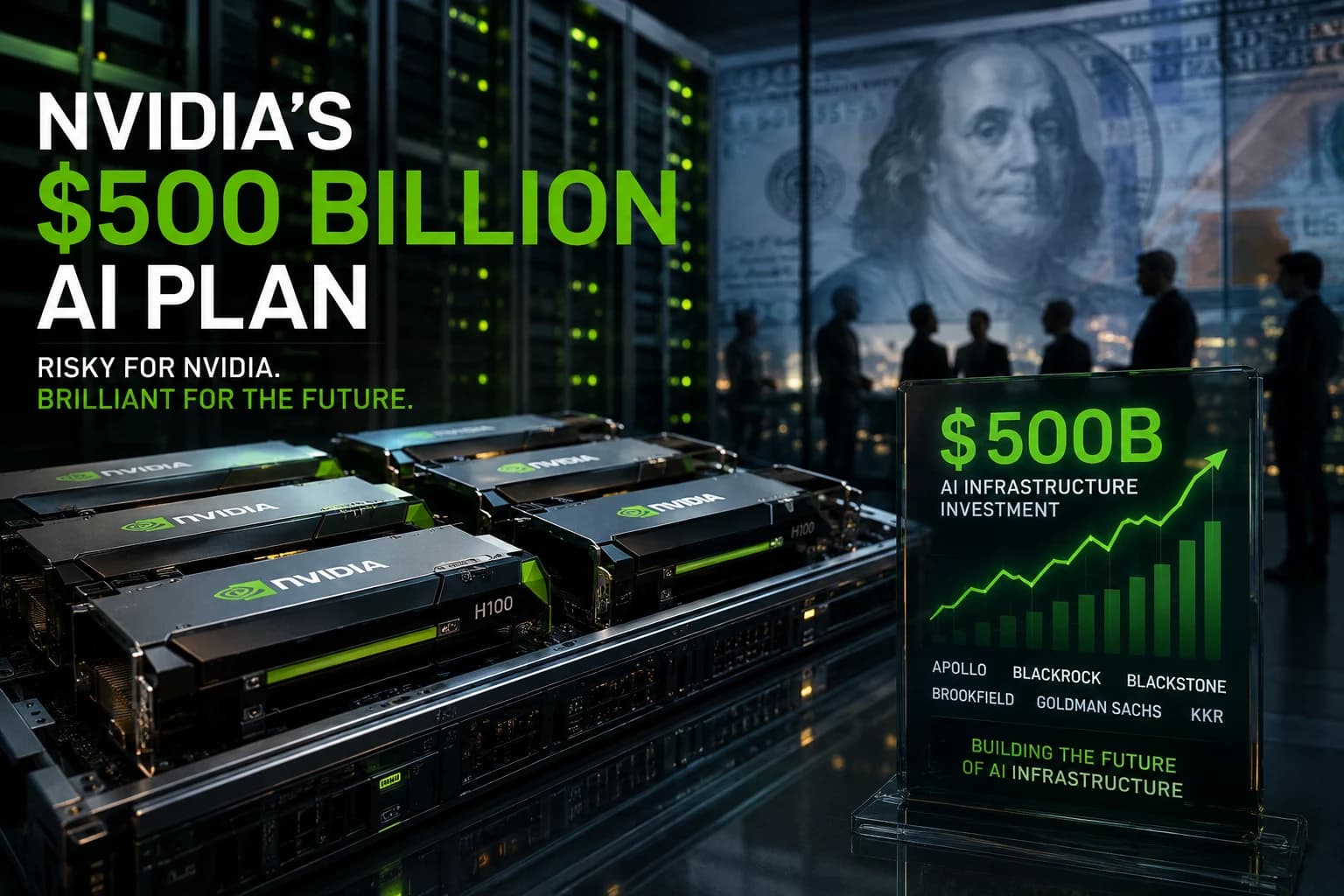
Nvidia's $500 Billion AI Financing Plan Is Really About Aging GPUs
Nvidia's $500 billion AI financing plan aims to bring in major institutional capital for AI data centers. However, the plan's more significant aspect is what happens to Nvidia GPUs after they are no longer the newest hardware. On August 10, Nvidia announced partnerships with Apollo, BlackRock, Blackstone, Brookfield, Goldman Sachs, and KKR to create independent financing platforms capable of mobilizing over $500 billion in third-party capital. The bigger strategic bet is that AI compute can remain valuable long enough to behave like infrastructure rather than disposable technology.
This distinction matters because AI hardware normally has a difficult financing problem. Lenders can understand the revenue generated by a data center, but they also need to decide what happens if the customer defaults and the GPUs have to be sold. Nvidia argues that its hardware should retain meaningful residual value because the machines can move between customers, clouds, and operators, while CUDA software can keep older systems useful across different workloads.
How Nvidia's $500 Billion Financing Plan Works
The headline number needs some qualification. Nvidia has not raised $500 billion itself, and the announcement is not a single $500 billion fund. The companies have signed memorandums of understanding to establish financing platforms, with final agreements still required. Nvidia says the platforms will independently underwrite projects and provide capital for AI infrastructure across its ecosystem.
This structure is important for Nvidia because it potentially expands customers' ability to buy and operate large amounts of compute without forcing Nvidia to finance the entire buildout on its own balance sheet. For institutional investors, the attraction is different: AI infrastructure could become a new category of long-duration assets capable of generating recurring cash flow.
Nvidia has discussed residual-value support of up to 25% of an opportunity on a project-by-project basis. This is significant because it can reduce the downside that lenders face if the value of the underlying GPUs falls. However, the exact contractual mechanics have not been publicly disclosed. It is more precise to describe this as potential residual-value support rather than assume Nvidia has promised a blanket 25% guarantee on every project.
Nvidia's financing model has another problem: its exposure can increase precisely when the underlying AI market becomes weaker. This is known in finance as wrong-way risk. If AI demand remains strong, GPU values should be supported, and Nvidia benefits from continued hardware sales. If demand falls sharply, however, GPU resale values could decline at the same time that Nvidia faces larger obligations tied to its residual-value support.
The Real Nvidia Strategy Is Creating a Used-GPU Market
The most interesting part of the Nvidia $500 billion financing plan is what it could do to the secondary market for AI hardware. Today's most powerful GPU becomes tomorrow's older generation surprisingly quickly. If lenders believe a three-year-old system will have little value when a loan matures, financing that system becomes expensive or unattractive.
Nvidia wants to change that calculation. If an older GPU can be transferred from one AI lab to another, rented by a different cloud provider, or redeployed for inference, fine-tuning, and other workloads, its economic life can extend beyond the first customer. This creates more potential buyers and users for the same hardware.
When needs change, the factory can be used by another customer, another cloud, or another operator., Jensen Huang, Nvidia CEO.
Nvidia's software ecosystem becomes financially important here. CUDA gives Nvidia hardware a large installed base of developers and applications, which can make older GPUs more useful than a simple comparison of raw performance might suggest. Nvidia is not merely selling faster chips; it is trying to make the entire installed base more liquid.
Why Aging GPUs Are the Hardest Part of the Bet
The central risk is technological obsolescence. AI infrastructure is not a railroad track that can remain productive for generations without major changes. New GPU architectures, better accelerators, custom chips, more efficient models, and improved inference techniques can reduce the economic value of older equipment before its financing has been fully repaid.
Amazon provides a useful warning about the speed of hardware change. The company shortened the estimated useful life of certain servers and networking equipment from six years to five beginning in 2025, citing the faster pace of technology development, particularly in AI and machine learning. This does not mean Nvidia GPUs specifically have a five-year life, but it shows why depreciation assumptions have become a major issue in AI infrastructure economics.
The comparison with Lucent Technologies has emerged for this reason. Lucent used customer financing to help support sales during the telecommunications boom, and its collapse became a cautionary example of how vendor financing can amplify a technology bubble. Nvidia's current structure is different because the announced platforms are intended to bring independent institutional capital into AI infrastructure rather than have Nvidia finance the entire market itself.
Nvidia Faces Wrong-Way Risk If AI Demand Weakens
Nvidia's exposure can increase precisely when the underlying AI market becomes weaker. This is known in finance as wrong-way risk. If AI demand remains strong, GPU values should be supported, and Nvidia benefits from continued hardware sales. If demand falls sharply, however, GPU resale values could decline at the same time that Nvidia faces larger obligations tied to its residual-value support.
The risk is different from simply guaranteeing a customer's loan. Nvidia's potential exposure is connected to the same technology cycle that drives its revenue. A prolonged slowdown could therefore hit both sides of the equation: fewer new GPU purchases and greater pressure on the value of existing GPUs.
Nvidia Is Trying to Turn Compute Into Infrastructure
Nvidia's larger argument is that AI compute should be financed more like productive infrastructure than conventional technology equipment. Its press release describes compute as an investable asset supported by long-lived demand, transferable equipment, and a large ecosystem of potential users. The financial industry is being asked to accept that an AI factory can continue producing economic value even as individual generations of GPUs age.
This could have major consequences if the thesis works. A lender would no longer need to assume that an older GPU becomes nearly worthless after its first deployment. Instead, the lender could value the combination of contracted compute revenue, redeployment options, and secondary-market demand.
The distinction between revenue and residual value is critical, though. A GPU generating strong rental income today does not automatically have a strong resale price several years from now. The financing only works if the equipment produces enough cash flow during its useful economic life to repay the debt, with residual value serving as an additional layer of protection rather than the foundation of the deal.
What Nvidia's Plan Could Mean for Startups and Enterprises
If Nvidia succeeds in establishing a liquid secondary market, the beneficiaries could extend far beyond the largest AI laboratories. Startups that cannot afford the newest GPU generation could gain access to older hardware at lower prices. Enterprises could build specialized inference systems without always buying the latest accelerators. Researchers could use previous-generation hardware for workloads where maximum performance is unnecessary.
This would also change the economics of AI infrastructure. Instead of a simple cycle in which companies buy new GPUs, operate them, and eventually scrap or heavily discount them, the industry could develop a deeper equipment market with multiple owners and users over a GPU's lifetime.
For Nvidia, that would be strategically powerful. A functioning secondary market would make customers more comfortable financing new hardware because they could expect to recover some value later. That, in turn, could support demand for the next generation of Nvidia systems. The company would benefit from both the initial sale and a larger ecosystem that keeps older Nvidia hardware economically useful.
The $500 Billion Plan Will Be Tested by Contracts, Not Headlines
Nvidia's $500 billion financing plan is ambitious because it attempts to solve two problems at once: finding enough capital to build AI infrastructure and convincing lenders that rapidly aging AI hardware can serve as durable collateral. The first problem is primarily financial. The second is technological, and it is harder.
The decisive evidence will come from the actual financing agreements. Investors will need to see how long the debt runs, who has contracted to use the compute, how quickly the hardware is expected to depreciate, how equipment can be redeployed, and exactly where Nvidia's residual-value support begins and ends. Nvidia says the financing platforms will independently underwrite projects, but the details of those contracts will determine whether institutional capital is truly accepting the risk or simply being partially protected by Nvidia.
If AI demand keeps expanding and older GPUs retain useful workloads, Nvidia may have found a way to turn hardware depreciation from a weakness into an advantage. A large secondary market would make every generation of its compute more reusable, easier to finance, and potentially more valuable over time.
If AI demand slows while new architectures rapidly outperform older ones, the same financial structure could expose Nvidia to losses when its own revenue is under pressure. That is why the most important number in the announcement is not actually $500 billion. It is the residual value of the GPUs when the loans come due.