Anthropic AI Watermark: What Claude's New Mark Means
Anthropic is adding invisible watermarks to Claude-generated text to meet EU transparency rules. Here's how the technology works and what it means for AI content.
Anthropic AI Watermarking Is Coming to Claude
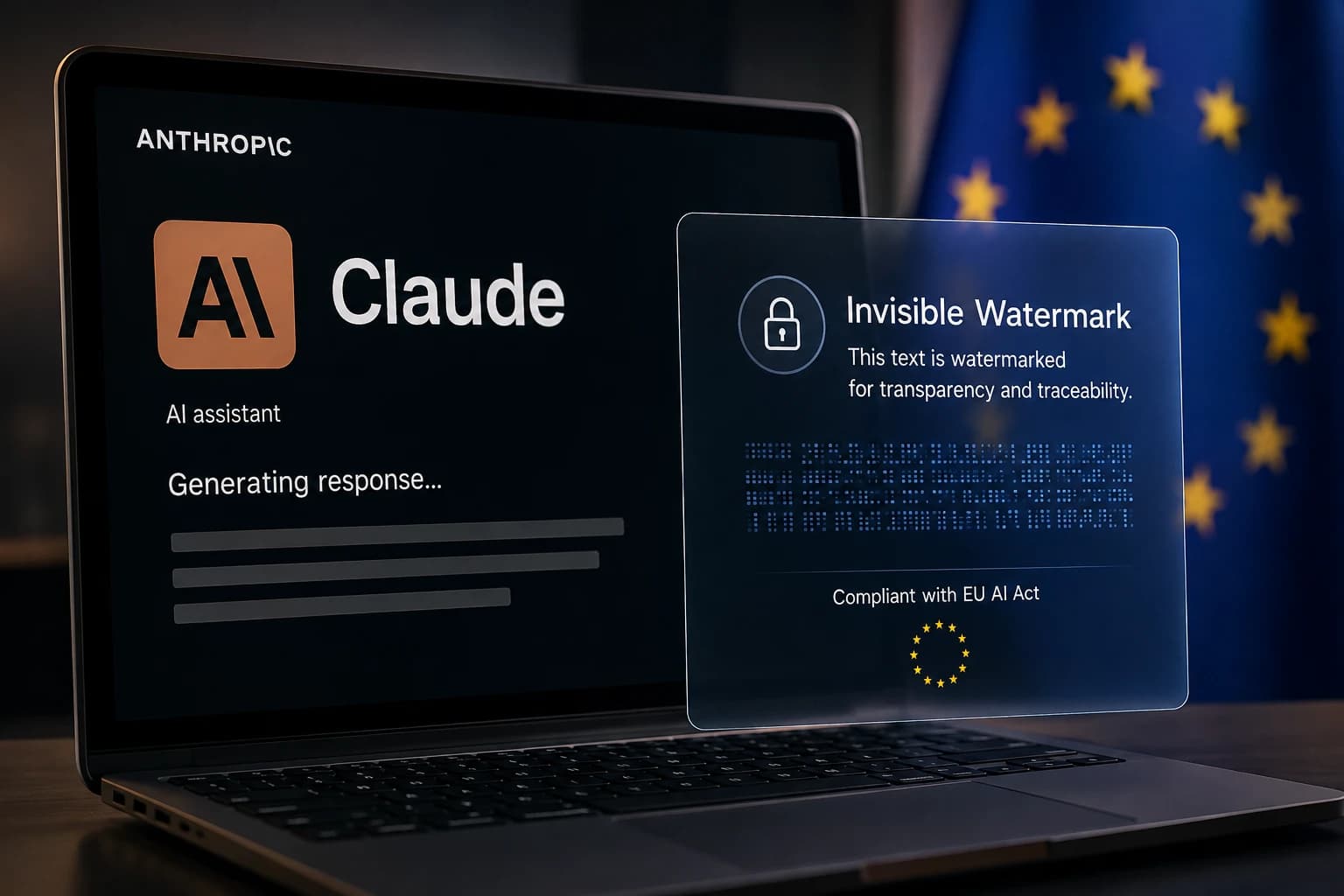
Anthropic is adding invisible, machine-readable watermarks to text generated by Claude, with the change applying to supported models launched from August 2, 2026. The company says the marks are designed to help identify AI-generated content and fulfill its commitments under the European Union's AI Act transparency rules. Unlike a visible label, the watermark is embedded directly into the generated text, so users will not see it during normal reading or editing.
How Anthropic's AI Watermark Works
Anthropic says the watermark is woven into the text at the model level. That means the marking follows the output regardless of whether it comes from Claude's web product, API, Claude Code, Claude Cowork, or Claude Tag. It also applies when supported Claude models are accessed through cloud platforms including AWS, Google Cloud, and Microsoft Foundry. The company says the watermark travels with copied and pasted text and can survive some editing, although heavily edited, paraphrased, translated, or very short passages may no longer produce a reliable detectable signal.
"Because the watermark is part of the text, it will travel with the text when it's copied and pasted elsewhere, and may persist through some editing."
The distinction matters because this is not the same as putting a visible "AI-generated" notice above a Claude response. The mark is intended for machine detection rather than human readers. Anthropic says it is also developing detection support for users and third parties, with technical details to be published later. A detected mark, however, will only indicate that content may have been processed by Claude. It will not establish the complete history of a piece of writing or prove that every sentence was generated by AI.
Why the EU AI Act Is Driving AI Watermarking
The timing is closely tied to the EU AI Act. Article 50 transparency obligations began applying on August 2, 2026, covering machine-readable marking and detection of AI-generated or manipulated content in relevant cases. The European Commission says the rules are intended to reduce deception and manipulation and improve the ability of people and systems to recognize AI-generated material. Generative AI systems already placed on the market before August 2 have a limited transition period for the marking obligation until December 2, 2026.
Anthropic's approach also shows why the regulation is pushing companies toward technical provenance rather than relying entirely on visible disclosures. A visible label can disappear when content is copied into another service. An embedded machine-readable signal is designed to travel with the content itself, making it potentially useful to publishers, platforms, researchers, and other systems that need to assess where material came from.
Claude Text and Files Will Use Different Signals
Anthropic is using a second method for files. Supported generated files such as PNG, JPG, and SVG files can carry digitally signed provenance metadata based on the C2PA open standard. C2PA is designed to record information about the origin and history of digital content, while Anthropic's text watermark is embedded directly into the generated writing. The two approaches address the same provenance problem but operate differently.
This distinction is becoming increasingly common across the AI industry. Google has developed SynthID for watermarking AI-generated text and other media, while OpenAI uses C2PA Content Credentials and SynthID for its generated images. The broader shift is toward giving platforms a technical signal that can be checked without requiring users to trust a simple claim that content was made by an AI system.
The Biggest Weakness Is Detection Reliability
Watermarking does not solve the AI attribution problem by itself. Anthropic explicitly says a missing watermark does not prove that text was written by a human. A signal can become unreliable when writing is heavily edited, paraphrased, translated, or combined with other material, and very short passages may not contain enough text for dependable detection. That makes watermarking better understood as a provenance signal than as a universal AI detector.
That limitation is important for schools, publishers, employers, and platforms that may eventually use watermark detection to make decisions about authorship. A positive signal can provide evidence that Claude processed text, but it should not automatically be treated as proof that the entire document was written by Claude. Likewise, the absence of a signal cannot establish human authorship. The technology is strongest when combined with other evidence about how a document was produced.
What Anthropic's Watermark Means for Claude Users
For ordinary Claude users, the immediate change is largely invisible. The text should look and read normally, while supported models automatically add the machine-readable mark. The larger impact will appear when that content moves into other systems. Publishers, platforms, educators, and software developers could eventually use detection tools to identify Claude-generated material without relying on the user to disclose that Claude was involved.
The change also matters for businesses building products around Claude. Because the marking occurs at the model level, developers cannot simply avoid it by delivering Claude output through a different interface. Anthropic says organizations deploying Claude should independently assess their own obligations under Article 50, particularly when they build downstream products or publish AI-generated material.
AI Watermarks Could Become Part of the Internet's Provenance Layer
Anthropic's move is bigger than a single Claude feature. It reflects a shift toward treating AI provenance as infrastructure. As synthetic text, images, audio, and video become routine, platforms need ways to distinguish content origin without depending entirely on visual labels or unreliable AI detectors. The EU's transparency rules are accelerating that transition, while companies such as Anthropic, Google, and OpenAI are building different technical systems around the same basic problem.
The difficult question is whether these signals will remain reliable after content leaves the system that created it. Anthropic's own documentation acknowledges that editing and transformation can weaken detection. For now, the most realistic expectation is not that watermarks will prove who wrote every sentence, but that they will add another layer of evidence about how digital content was produced. That could become increasingly important as regulators, publishers, platforms, and users demand clearer answers about the origin of AI-generated material.