Nvidia Stock Rises After Amazon Earnings Boost AI Confidence
Amazon's latest earnings reassured investors that AI infrastructure spending remains strong. Here's why AWS's continued reliance on Nvidia GPUs helped lift Nvidia stock despite Amazon's growing investment in custom AI chips.
Nvidia Stock Rises After Amazon Earnings Reinforce the AI Spending Story
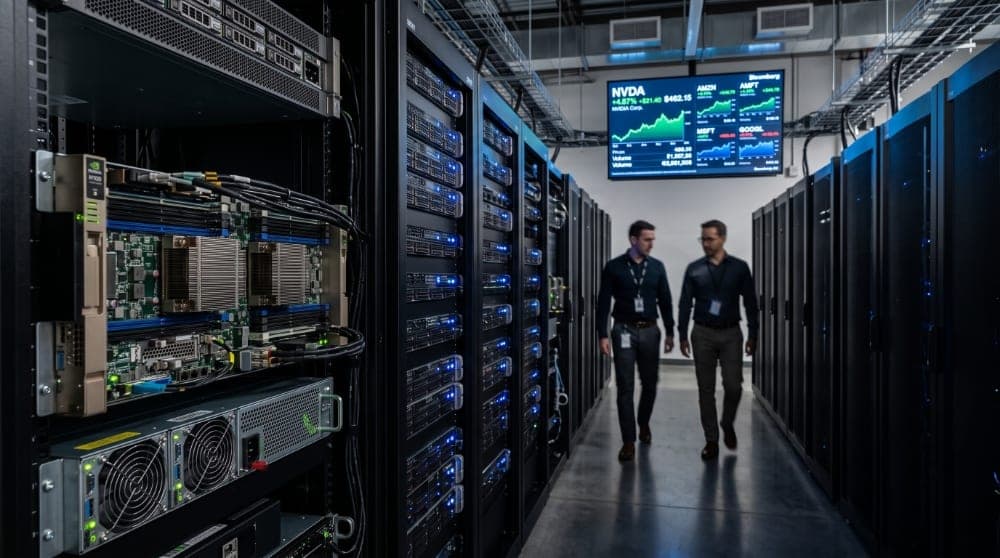
Nvidia stock climbed on Friday after Amazon delivered stronger-than-expected quarterly results, reaffirming that demand for AI infrastructure remains exceptionally strong. Amazon is developing its own custom AI chips, but executives made clear that Nvidia's GPUs continue to play a central role inside Amazon Web Services (AWS). This message was interpreted as evidence that hyperscale cloud providers are still spending aggressively on Nvidia-powered AI systems, helping lift Nvidia shares and reinforcing confidence in the company's long-term growth.
Amazon's AI Spending Matters Far Beyond Amazon
Amazon is one of the world's largest buyers of AI hardware. Every increase in its capital expenditure budget sends a signal to investors about demand across the AI infrastructure market. The company raised its expected 2026 capital spending to roughly $220 billion, citing continued investment in AI data centers and supporting infrastructure. This increase suggests cloud providers still see enough customer demand to justify unprecedented levels of spending.
"AWS is the best place to run Nvidia GPUs." -- Amazon CEO Andy Jassy, discussing AWS's continued partnership with Nvidia.
This statement carried particular weight because Amazon has simultaneously invested billions in developing its own Trainium AI accelerators. Rather than positioning custom silicon as a replacement for Nvidia, management described the chips as another option for customers with different workloads. The message was that AI computing demand has become large enough for multiple chip architectures to coexist.
Why Investors Care About Nvidia More Than Amazon's Own Chips
One of the biggest questions surrounding Nvidia has been whether major cloud companies will gradually replace its GPUs with internally designed processors. Amazon, Google, Microsoft, and Meta have all invested heavily in custom AI silicon to reduce costs and gain greater control over their infrastructure. Yet the market has repeatedly shown that developing competitive hardware does not automatically eliminate demand for Nvidia's products.
Nvidia continues to dominate the market for training large AI models because its advantage extends beyond hardware. Its CUDA software platform, networking products, developer ecosystem, and optimized AI libraries create switching costs that make it difficult for enterprises to migrate away from Nvidia even when alternatives become available.
AWS Growth Reinforces the AI Infrastructure Cycle
Amazon's AWS business reported one of its strongest growth periods in years, helped by increasing enterprise demand for AI services. Companies building generative AI applications require enormous computing capacity, much of which runs on Nvidia GPUs inside hyperscale cloud data centers. Faster cloud growth therefore strengthens the investment case not only for Amazon but also for suppliers across the AI infrastructure stack, including Nvidia.
Strong AWS results also suggest that enterprise AI adoption continues expanding beyond experimentation. Businesses are increasingly paying for production AI workloads, requiring sustained investment in computing capacity rather than one-time hardware purchases. This creates recurring demand for advanced accelerators and supporting networking equipment.
Custom AI Chips Are Expanding the Market, Not Shrinking It
Amazon's comments illustrate an important shift in how investors view custom AI chips. Earlier concerns centered on whether Trainium, Google's TPUs, or Microsoft's Maia chips would reduce Nvidia's market share. The discussion has shifted toward workload optimization. Custom chips often target inference or specific cloud services, while Nvidia remains the preferred platform for many AI training workloads and high-performance computing applications.
This distinction matters because the AI market itself continues expanding rapidly. As cloud providers deploy more AI infrastructure, overall demand for accelerators grows even if individual workloads migrate between chip types. That dynamic allows Nvidia to continue growing alongside custom silicon rather than necessarily losing business to it.
What Investors Should Watch Next
Amazon's earnings strengthened one of the market's most important investment themes: hyperscale companies remain willing to spend aggressively on AI infrastructure despite enormous capital requirements. As long as cloud providers continue expanding data center capacity and enterprise customers keep adopting AI services, Nvidia remains positioned to benefit from that investment cycle.
The next phase of the story will depend less on quarterly stock moves and more on whether AI spending continues translating into sustainable revenue growth across the cloud industry. Investors will closely monitor future capital expenditure guidance from major technology companies, adoption of custom AI chips, and Nvidia's ability to maintain its leadership in both hardware and software as competition intensifies.