K-Shaped Economy: Why America's Wealth Gap Is Narrowing
The K-shaped economy may be narrowing as lower-income Americans see stronger wage and spending growth, challenging the long-running story of a widening divide.
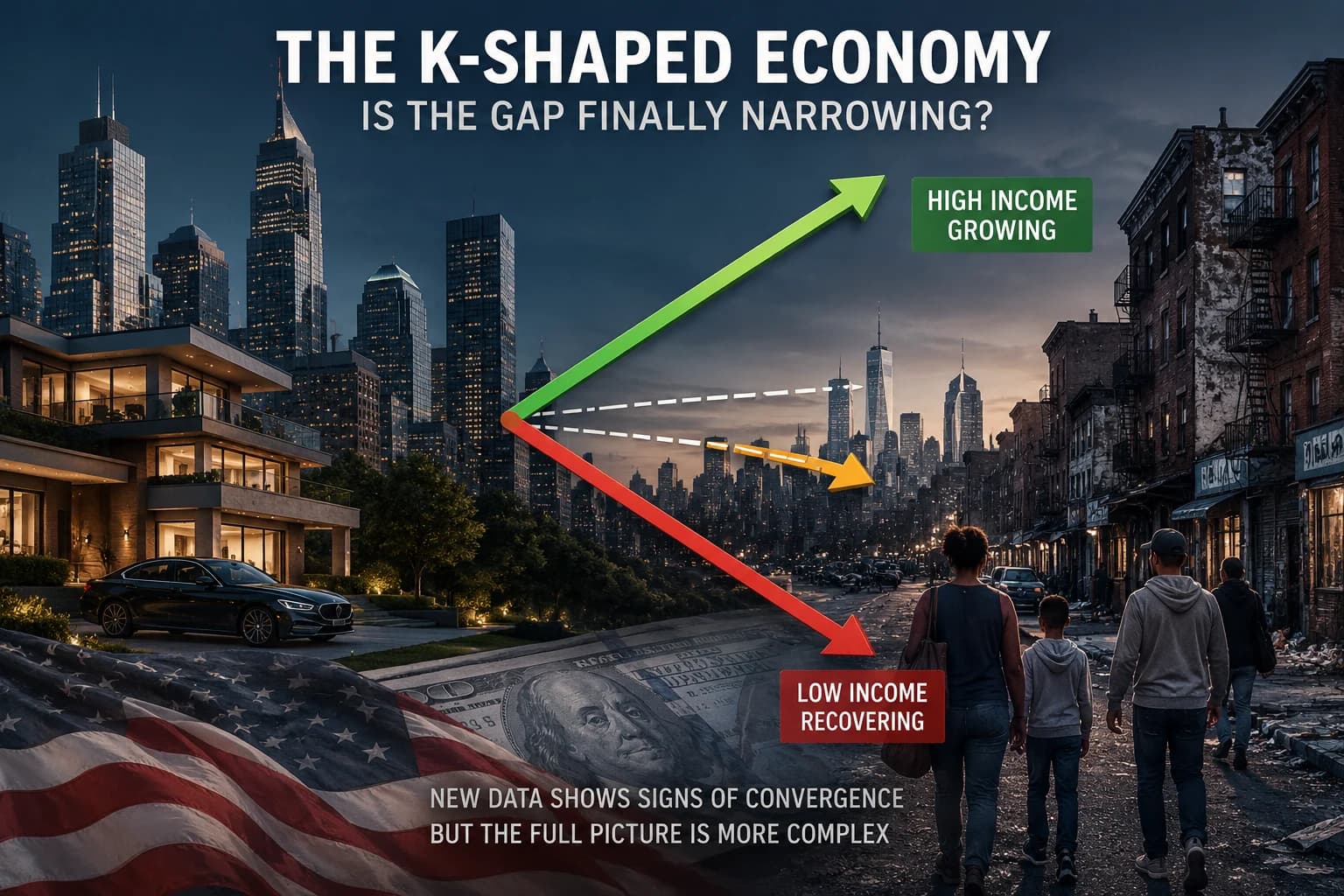
The K-Shaped Economy May Be Narrowing - But the Story Is More Complicated
Recent data from PNC and Bank of America indicate that lower-income households have begun closing the gap with higher-income households in spending and wage growth. PNC found that lower-income spending growth reached 4.9% year over year in June, only 0.8 percentage points below upper-income household spending growth. This shift challenges the simple version of the K-shaped economy narrative.
Why the K-Shaped Economy Became the Dominant Story
The term K-shaped economy became popular after the pandemic because the recovery did not benefit Americans evenly. Higher-income households were better positioned to benefit from rising financial assets, strong employment in professional industries and the economic reopening. Lower-income households faced greater exposure to inflation, weaker financial buffers and disruptions in lower-wage industries.
Consumer spending data reinforced that idea. A Federal Reserve study published in May found that from 2021 through 2025, spending by households in the top 40% of the income distribution grew substantially faster than spending among lower-income households. The Fed researchers concluded that the difference pointed to widening consumption inequality.
Lower-Income Spending Is Finally Catching Up
The most important change in 2026 is not that the income divide has disappeared. It is that some of the indicators used to measure the divide are moving closer together. PNC reported that lower-income spending growth accelerated from 1.7% at the end of 2025 to 4.9% in June, leaving it just 0.8 percentage points below upper-income spending growth.
Bank of America data point in the same direction. Its June research showed improving spending and wage growth among lower- and middle-income households, while its economic insights noted that lower-income wage growth accelerated as payroll conditions improved. The narrowing is therefore not based on a single spending category.
The K-Shaped Economy Is Not Simply Disappearing
The stronger argument is that the K has softened rather than vanished. Recent data still show important differences between households. The Federal Reserve research covering 2021 through 2025 found that higher-income households increased spending much faster than lower-income households over that period.
Wealth is an even bigger reason to be cautious about declaring the K-shaped economy finished. Income and spending can converge temporarily without eliminating the differences created by home ownership, stock holdings, retirement assets and access to credit. Higher-income households generally have more exposure to appreciating financial and real-estate assets.
Why 2026 Looks Different
Several forces may be helping lower-income households close part of the gap. Larger tax refunds have put additional cash into household budgets, while improving employment conditions have supported wage growth. PNC also identified World Cup-related spending, lower gasoline prices and the timing of Prime Day as factors that boosted consumer spending in June.
The timing matters because temporary boosts can make economic inequality appear to narrow even when structural differences remain. A tax refund can increase spending for a few months, but it does not necessarily change a household's long-term income, savings or net worth.
Scott Bessent Says the K Is Over
"I can say here, definitively, the K-shaped economy is over." - Treasury Secretary Scott Bessent
Treasury Secretary Scott Bessent has gone further than the data alone, arguing that the economy is becoming more "C-shaped" as outcomes at the top and bottom begin moving closer together. He has pointed to stronger wage gains for lower-paid full-time workers as evidence for that shift.
For investors, the real question is not whether economists can replace the letter K with C, E or another shape. The useful question is whether lower-income consumers can sustain stronger income and spending growth without relying on temporary fiscal support. If they can, the change could broaden the foundation of U.S. consumer demand and reduce some of the economy's dependence on affluent households.
What Investors Should Watch Next
The next signals to watch are lower-income wage growth, employment, discretionary spending, household savings and credit use. If those measures continue improving together, the case for a genuinely less divided consumer economy will become stronger. If spending falls back after temporary tax refunds and other one-off boosts, the K-shaped economy may prove to have narrowed without actually disappearing.
America May Be Moving Beyond the Simple K-Shaped Economy
The latest evidence does challenge the idea that the U.S. economy in 2026 can be described simply as rich households getting stronger while poorer households get weaker. Lower-income spending and wages have improved, and the gap with higher-income households has narrowed in several recent measures. But that is different from saying America's wealth divide has been solved.